
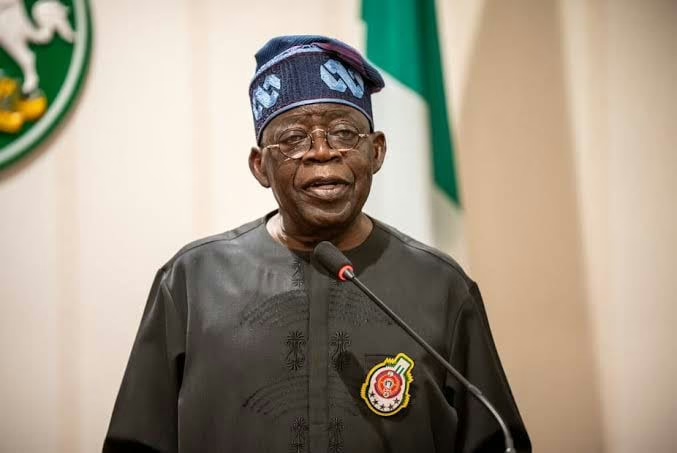
President Bola Ahmed Tinubu on Wednesday directed ministers and senior government officials to obtain his approval before requesting police escorts for official engagements. This directive was issued during the Federal Executive Council (FEC) meeting held at the State House in Abuja.
The instruction follows the November 23 order mandating the withdrawal of police officers attached to Very Important Persons (VIPs) across the country. This earlier directive emerged after a security meeting that the President held with service chiefs, including the heads of the police, air force, army, and the director-general of the DSS.
Under the new arrangement, VIPs in need of protection are expected to request well-armed personnel from the Nigeria Security and Civil Defence Corps (NSCDC). President Tinubu also approved the recruitment of 30,000 additional police officers and pledged collaboration with state governments to upgrade police training facilities nationwide. This decision comes amid rising security concerns, including killings and kidnapping attacks, particularly the abduction of students from schools.
Addressing the FEC, Tinubu stressed that the redeployment of police officers attached to VIPs, VVIPs, and ministers was non-negotiable. He ordered all affected officials, including ministers, to comply immediately. Tinubu directed the National Security Adviser (NSA), Nuhu Ribadu; the Minister of Police Affairs, Senator Ibrahim Gaidam; and the Inspector-General of Police (IGP), Kayode Egbetokun, to ensure full implementation of the directive.
“I have told the Inspector-General of Police, and I hope the Minister of Police Affairs is here to implement the directive. If you have any problem with security due to the nature of your assignment, please contact the IGP and get my clearance,” he stated.
The President also instructed the Minister of Interior to collaborate with the IGP and NSCDC to fill gaps created by the withdrawal of officers on special duties. He said, “The Minister of Interior should liaise with the IGP and Civil Defence to replace those police officers who are on special security duties, so that people are not left exposed.”
Tinubu emphasised that police officers are primarily trained to protect the lives and property of citizens—particularly the most vulnerable—rather than providing security for a select group of VIPs. He assured that the police would be properly mobilised to confront national security challenges.
The President further directed the NSA and DSS to review the country’s security architecture and implement necessary adjustments. Citing heightened security threats nationwide, Tinubu insisted that the directive must be enforced without delay. He acknowledged that some officials faced high exposure risks and highlighted the need to strengthen community security structures, including forest guards.
“I know some of our people are exposed, and we must make exceptional provision for them. The civil defence is equally armed, and I want to know from the NSA if we are to arm our forest guards too. We should take it very seriously,” he said.
President Tinubu also urged Vice President Kashim Shettima, who chairs the National Economic Council (NEC), to further sensitise governors and other stakeholders on the implementation of ranching reforms. The President directed the Minister of Livestock Development, Idi Muktar Maiha, to begin the mobilisation process, focusing particularly on conflict-prone areas.
He stated, “The Minister of Livestock should identify which villages or grazing areas can be rehabilitated for ranching. We must eliminate these areas of conflict and make livestock reform economically viable. The opportunity is there—let’s utilise it. You should emphasise the constitutional requirement that land belongs to the state.”
Senator Ningi Protests Selective Enforcement
Meanwhile, the Senator representing Bauchi Central, Abdul Ningi, raised a point of order on the Senate floor on Wednesday to protest the withdrawal of his only police orderly. He insisted that the enforcement of the President’s new security directive must apply uniformly across all privileged Nigerians.
Ningi informed lawmakers that while his orderly had been withdrawn in compliance with the directive issued by the presidency and the Inspector-General of Police, numerous political officeholders, business elites, and even entertainers continued to enjoy full police escorts.
He stated, “It should be done across the board. Let us see what happens from the office of the President to the Vice President, the Senate President, the Speaker of the House, ministers, governors, business concerns—even the sons and daughters of political office holders. I have seen singers and foreign business owners with police escorts. But a senator has his only orderly withdrawn. It is unfair.”
Responding, Deputy Senate President Barau Jibrin, who presided over the plenary, acknowledged Ningi’s concerns and stated that the issue had already been discussed at a leadership meeting on Tuesday. He assured senators that the chamber was “on top of the situation” and had begun engagements with the relevant authorities.
Barau directed the chairman of the Senate Committee on Police Affairs to investigate the alleged selective application of the directive, stressing that President Bola Ahmed Tinubu issued the order in good faith to strengthen internal security by redeploying officers to core policing duties.
Soyinka Tackles Tinubu Over Heavy Security Around Son
Nobel Laureate Wole Soyinka has criticised what he described as an excessive deployment of security personnel around Seyi, the son of President Tinubu. Soyinka, who is considered an ally of the President and was conferred with a national honour in June 2025, expressed concern over the scale of protection, raising questions about Nigeria’s priorities and security management.
He recounted witnessing what he initially thought was a film shoot at a hotel in the Ikoyi area of Lagos, only to discover it was a security detail assigned to the President’s son. “I was coming out of my hotel, and I saw what looked like a film set. A young man detached himself from the group and greeted me very politely. I asked jokingly if they were shooting a film,” he recounted.
Soyinka observed that the environment was occupied by a large team of armed personnel. “I looked around, and there was nearly a whole battalion occupying the grounds of the hotel in Ikoyi. There were at least 15 or so heavily armed security personnel. They looked sufficient to take over a small neighbouring country like Benin,” he said.
“I was so astonished that I started looking for the National Security Adviser. I said I have seen something I cannot believe. I asked if a child of the head of state goes around with an army for his protection.”
Later, he remarked that President Tinubu did not need to mobilise the military to quell instability in neighbouring Benin Republic, suggesting that the security personnel attached to his son were enough to subdue any uprising. “Tinubu did not have to send the air force and the military to deal with that insurrection. There is an easier way. The president should just call that young man and say, Seyi, go and put down those people. You have troops under your command,” he jested.
Soyinka emphasised that while leaders across the world have children, public office should not be used to confer undue power or privilege upon them. “This is not the first country whose head of state has a family. Children should know their place. They are not potentates. They are not heads of state,” he stated.
He concluded that such a display of force distorts the country’s security priorities. “The security architecture of a nation suffers when we see such heavy devotion of security to one young individual,” he added.



Leave a Reply