
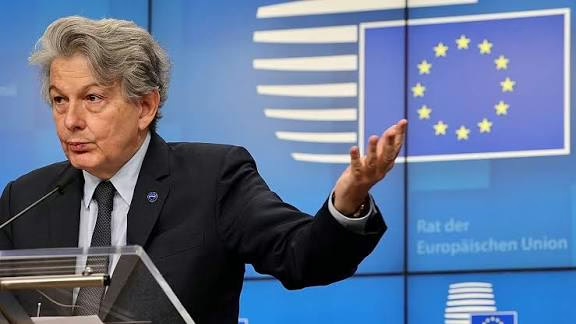
The United States has imposed visa bans on five foreign individuals, including a former European Union commissioner, over allegations of attempting to pressure American social media companies to suppress certain viewpoints.
U.S. Secretary of State Marco Rubio announced the decision on Tuesday, accusing the affected individuals of participating in what he described as a coordinated campaign to promote censorship targeting American speakers and technology firms.
“These radical activists and weaponised NGOs have advanced censorship crackdowns by foreign states, in each case targeting American speakers and American companies,” Rubio said in a statement, according to the BBC.
Among those sanctioned is Thierry Breton, former European Commissioner for the Internal Market, who played a central role in shaping the EU’s Digital Services Act (DSA) — legislation that imposes strict content moderation rules on large technology platforms.
The U.S. State Department described Breton as the “mastermind” behind the DSA, which has faced criticism from some U.S. conservatives who argue that the law suppresses right-wing and dissenting opinions online. European Union officials have consistently rejected those claims, insisting the legislation is aimed at combating illegal content and online disinformation.
Reacting to the visa ban, Breton dismissed the allegations, describing the move as a “witch hunt” and suggesting he was being unfairly targeted. “To our American friends: Censorship isn’t where you think it is,” he said.
Breton has previously clashed with Elon Musk, owner of social media platform X, over compliance with EU digital regulations. Earlier this year, the European Commission fined X €120 million under the DSA over its blue-tick verification system, which regulators said was deceptive because users were not meaningfully verified. X later blocked the Commission from advertising on the platform.
Also affected by the visa restrictions is Clare Melford, head of the UK-based Global Disinformation Index (GDI). U.S. Undersecretary of State Sarah B. Rogers accused the organisation of using American taxpayer funds to promote censorship and blacklist U.S. media outlets.
A spokesperson for GDI condemned the sanctions, calling them “an authoritarian attack on free speech” and accusing the Trump administration of using government power to silence critics.
Imran Ahmed, founder of the Center for Countering Digital Hate (CCDH), was also placed under visa restrictions. Rogers described Ahmed as a key collaborator in what she termed efforts by previous U.S. administrations to “weaponize” government authority against American citizens.
Two executives of the German organisation HateAid — Anna-Lena von Hodenberg and Josephine Ballon — were similarly sanctioned. The State Department said HateAid had played a role in enforcing the DSA.
In a joint statement to the BBC, the HateAid executives described the visa bans as “an act of repression” and accused the U.S. government of attempting to silence human rights advocates under the guise of defending free speech.
Rubio said the measures were directed at what he called “agents of the global censorship-industrial complex,” adding that those affected would generally be barred from entering the United States.
“President Trump has been clear that his America First foreign policy rejects violations of American sovereignty,” Rubio said. “Extraterritorial overreach by foreign censors targeting American speech is no exception.”





Leave a Reply