
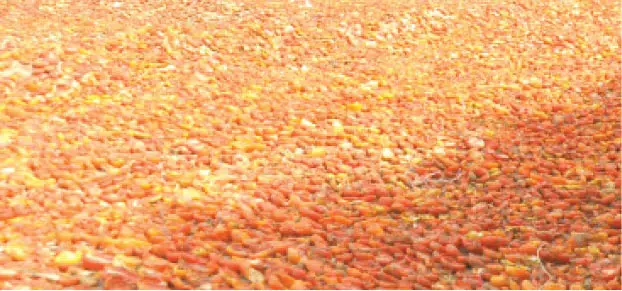
Tomato farmers in Kano, Katsina, Kaduna, Plateau, and other states are currently facing a significant price crash as the harvest season begins, compounding the challenges they already face. Following the catastrophic Tuta absoluta outbreak that ravaged crops and inflicted billions of naira in losses on the tomato industry, farmers are now grappling with an oversupply of tomatoes in the market.
A report by Daily Trust indicates that markets are flooded with fresh tomatoes, leading to a sharp decline in prices and heavy financial losses for farmers who had heavily invested to recover from previous setbacks caused by the pest attack.
Over the past few years, infestations of Tuta absoluta, a highly damaging tomato leaf miner, have wreaked havoc on farms in northern tomato-growing regions. These outbreaks have destroyed vast areas of cultivated land, compelling numerous farmers to cease production and significantly impacting supply chains. Many farmers are now facing financial distress due to mounting debts.
In 2016, the first outbreak of Tuta absoluta devastated tomato crops in seven northern states: Jigawa, Kano, Katsina, Kaduna, Plateau, Gombe, and Nasarawa. The pest has since spread to two additional states in the South-West region: Lagos and Oyo.
In Kano State, Malam Abba Ibrahim Kalla of Bunkure Local Government Area told our correspondent that returning to the farm was very difficult due to the significant losses he incurred last year from the pest attack. He explained that he was only able to return to the farm this dry season with the assistance of a loan from his associates.
Malam Kalla noted that despite the recent commencement of the harvest season, early signs indicate that farmers are likely to face losses due to the surplus of tomatoes in the market, which is inevitably leading to a sharp decline in prices. Our correspondent who visited some tomato markets revealed that a full basket of tomatoes is now selling for less than N10,000, while a crate is selling for less than N3,000, far below production costs.
A basket of tomatoes, which once fetched over N25,000, now sells at a fraction of that price. Farmers lament their inability to recoup expenses for fertiliser, seeds, chemicals, labour, and transportation.
Another farmer, Idris Muhammed, acknowledged the commitment of research institutions and other agencies in tackling the Tuta issue, which has helped many farmers improve their skills in combatting the pest. However, he expressed concern over the unfortunate glut in most markets across the growing areas.
“With improved pest control measures and renewed confidence, many farmers returned to tomato cultivation this season. Ironically, the rebound in production has now resulted in excess supply, outpacing market demand, resulting in the glut we are witnessing now,” he said.
In Kaduna State, farmers raised serious concerns about the rising cost of fertiliser, recurring tomato diseases, poor storage facilities, and unstable electricity supply, warning that these challenges threaten their livelihoods and the sustainability of tomato production in Nigeria.
A tomato farmer in Hunkuyi town, Kudan Local Government Area of Kaduna State, Alhaji Auwal Ibrahim Hunkuyi, stated that the high cost of fertiliser is progressively crippling tomato farming. Speaking with Weekend Trust, Alhaji Auwal lamented that “this year, tomato farming faced many challenges and the price of tomatoes collapsed in the market. But what worries us most is the high cost of fertiliser. That is the real problem facing tomato farmers.
“Today, a bag of fertiliser is sold at N50,000, yet you end up selling tomatoes at N1,700 to N3,000 per kilogram. That alone shows that something is seriously wrong.”
He further explained that many farmers are forced to continue farming not because it is profitable, but because it is their only means of survival. “We are farming now because we need food, not because of profit. If you spend N1 million on a farm, it is very difficult to make N200,000 profit,” he said.
He detailed the rising costs involved in tomato production, including fuel for irrigation machines, agrochemicals, labour, and fertiliser. He explained, “When you calculate the cost of petrol for irrigation engines, chemicals for spraying, payment for labourers, and the cost of fertiliser, you will not even make N200,000 profit. In fact, most times, you run at a loss.
“Last year, a bag of maize was sold at N60,000, but now it has dropped to N18,000. With that same money, you farm tomatoes, and at the end of the season, people come and buy them at N3,000 per kilo. Where is the profit in that?”
He added that the situation makes it appear as if farmers are only working for fertiliser dealers.
Meanwhile, the assistant chairman of the Tomato Leda Cooperative Societies and Sellers at Mugadishu Market, Kaduna, Hafiz Umar, noted that tomato supply had improved due to a reduction in pest infestations, largely attributed to the cold season.
“There is improvement now because it is the cold season. The tomato pest problem has reduced significantly,” he said.
Hafiz recalled that in previous years, the situation was worse, forcing traders to seek tomatoes outside Nigeria. “It was not like this in the past. There was a time when tomatoes almost disappeared completely. We even had to travel to Cameroon to buy tomatoes because there were none in Nigeria,” he said.
According to him, the worst period is usually between March and May. “From March to April and May, when the weather is very hot, we face serious problems with tomato pests. But now, because we are in the cold season, there is much improvement,” he said.
On the current market prices, Hafiz Umar stated that tomato prices have dropped significantly. “At the moment, a basket of tomatoes sells for N10,000. A rubber container sells for N3,500 to N4,000, while a small nylon (leda) sells for N500 to N1,000,” he said.
He compared the prices to those of last year during the hot season. “Last year, during the hot season, we sold a basket at N60,000 to N100,000. A rubber container was N15,000 to N30,000, while a nylon was N5,000 to N10,000,” he recalled.
The women leader of the Tomatoes Market at Cele Bridge in Jos, Plateau State, Ruth Izang, told our correspondent that tomato prices had crashed, adding that many people are still blaming it on the disease that has yet to leave the farms in the state.
“The price of good tomatoes, the variety travellers prefer, is around N5,000 for a basket, while the price of other varieties that have a shorter shelf life ranges between N4,000 and N3,000.
“Around November and October last year, it was sold at N17,000, N16,000, and N15,000.
“Another reason for the tomato price crash in Plateau State is that tonnes of the commodity are flooding the market from Zaria,” she said.
Farms Still Under Pest Attack
On her part, Professor Juliana Mafuil, a tomato farmer and stakeholder in the value chain in Plateau State, also acknowledged that Tuta Absoluta is still ravaging tomato farms.
“There are lots of Tuta Absoluta in many farms; not only in Jos but even outside Jos. This is because Mangu and the rest of the places are also affected. That’s what is happening right now.
“The farmers, marketers, and everyone along the tomato value chain are not faring well right now in this situation. What else can they do? They are looking for what they can get to kill the disease over the years, but it has not been successful.
“They are just trying one thing or another, and some are not working. In fact, there are some new seeds that they brought for us from abroad. It is from an establishment in Japan. But it is still not working.
“So, I won’t say that Plateau State has come out of the tomato disease and related challenges right now because many farms are still affected, big time,” she said.
The secretary of the Tomato Growers, Processors, and Marketing Association of Nigeria, Plateau State chapter, Joshua Ngwen, told Weekend Trust that the disease has not gone away from Plateau yet, adding that farmers are still facing enormous challenges applying diverse techniques to stay afloat in tomato cultivation.
He said, “Honestly, the price of tomatoes is not favourable to me and most of us right now. If you check the cost of production, you would see that things have changed; and before you get a clean tomato right now that is free from any form of pest invasion attack is a problem.
“So, the farmers usually spend more now to get good products out. For instance, the price of tomatoes per basket is now between N3,000 and N4,000. That is even barely enough to cover the money you put into production.”
Absence of Cold Room
The situation is further worsened by the absence of adequate storage facilities, processing plants, and effective market linkages, forcing farmers to sell at giveaway prices, cut and dry, or watch their produce rot.
A vendor at the Kwanar Gafan tomato market, Alhaji Bello Sadik, said farmers have no option but to dry their produce to prevent spoilage. He noted that while this method is costly, it is preferable to allowing the tomatoes to rot.
Hafiz blamed the problem largely on poor electricity supply. “Lack of electricity is one of the main reasons we cannot preserve tomatoes,” he said.
He explained that stable electricity would encourage investment in storage and processing facilities. “If there was stable electricity in Nigeria, people would establish companies and cold rooms to preserve tomatoes. With electricity, tomatoes can be stored in cold rooms or freezers for up to one year without spoiling,” he added.
He noted, however, that unreliable power supply and the high cost of solar energy make preservation difficult. “Because electricity is not stable and solar power is expensive, most people cannot afford it. That is why tomatoes keep getting wasted,” he added.
He warned that as the farming season comes to an end, tomato scarcity may soon return. “Now that the farming season is ending, tomatoes are gradually becoming scarce because everyone needs them at home,” he said.
‘There Is Need for Action’
Alhaji Basheer Auwal, an agricultural expert from Kano, emphasised the need for immediate action to implement efficient and sustainable processing methods, value addition strategies, and structured market access schemes. Without these measures, he warned, the cyclical patterns of scarcity and surplus would persist, adversely affecting tomato farming and dissuading farmers from continuing in the industry.
He urged both the government and private investors to expedite the development of tomato processing facilities. He also advocated for the enhancement and provision of cold storage facilities at key tomato markets, as well as the promotion of export opportunities. These steps, he argued, are essential to stabilise prices and safeguard farmers’ incomes and investments.
Scaling Value Chains
HortiNigeria, a key tomato donor agency sponsored by the Dutch Government, noted that Nigerian farmers often face a frustrating reality: a bumper harvest can still mean financial loss. When market prices crash or fresh vegetables cannot be sold quickly enough, a large amount of perfectly good produce may spoil before it reaches consumers.
Mohammed Salasi Idris, who has over 25 years of experience in agricultural development, agro-input systems, and project management across Nigeria, and is the programme director for HortiNigeria, stated that for years, this cycle of post-harvest loss has eroded Nigerian farmers’ incomes and discouraged investment in the sector.
The National Horticultural Research Institute (NIHORT) and the International Institute of Tropical Agriculture (IITA), located in Ibadan, have been conducting research to break this cycle. For example, NIHORT scientists turned excess tomatoes into tomato wine, creating new opportunities for farmers.
The scientists developed a unique solution to this challenge through tomato wine. By processing surplus fresh tomatoes into a shelf-stable, value-added product, they created a new market pathway for farmers to transform excess produce into a premium beverage with a longer shelf life and year-round sales potential.
For farmers, the success of tomato wine would mean lower post-harvest losses and more reliable income streams.
HortiNigeria stated that introducing such a novel product to consumers is not without challenges. Tomato wine is unfamiliar to much of Nigeria’s population, and as with any innovation, it requires visibility, credibility, and demand to succeed, adding that it is facilitating business linkages and identifying ways to boost the marketability of tomato wine.
Stakeholders’ Appeal
Hafiz Umar, the assistant chairman of the Tomato Leda Cooperative Societies Sellers at Mugadishu Market, Kaduna, said, “The government needs to help farmers and traders by providing storage facilities so that tomatoes can be available all year round. This will also help reduce prices.”
Another trader, Shuaibu Abubakar Sadauki Yakawada, appealed to the government to intensify efforts to eliminate tomato diseases. He warned that failure to address the recurring challenges would have serious consequences. “If these problems continue, tomato farming and trading will face serious trouble, and that will affect our businesses and livelihoods,” he said.
FG’s Approach
The Minister of Agriculture and Food Security, Senator Abubakar Kyari, emphasised the importance of strategic and robust investment in tomatoes. This, he said, would boost productivity, minimise post-harvest losses, enhance food security, and deliver significant financial rewards to investors.
During a paper presentation at the Hand-in-Hand (HiH) Investment Forum in Abuja, the minister highlighted the significant economic advantages of tomatoes for the country. “The tomato investment, estimated at $869 million, targets 72,000 hectares in Kano, Bauchi, and Borno. It will halve post-harvest losses, raise yields to as much as 30 tonnes per hectare, and directly benefit 36,000 farmers. The investment is projected to deliver an internal rate of return (IRR) of 12.5 per cent and a net present value (NPV) of $171 million,” he said.
Kyari further stated that in terms of job creation, the federal government’s tomato value chain programme would directly benefit 36,000 farmers and indirectly impact more than 246,000 individuals through job creation and value chain participation.
He mentioned that it would also establish seed multiplication centres for high-quality inputs, clean energy-powered processing plants, including mobile units for rural areas, and stronger national institutions for quality assurance and agricultural research.
Credit: Daily Trust









Leave a Reply