
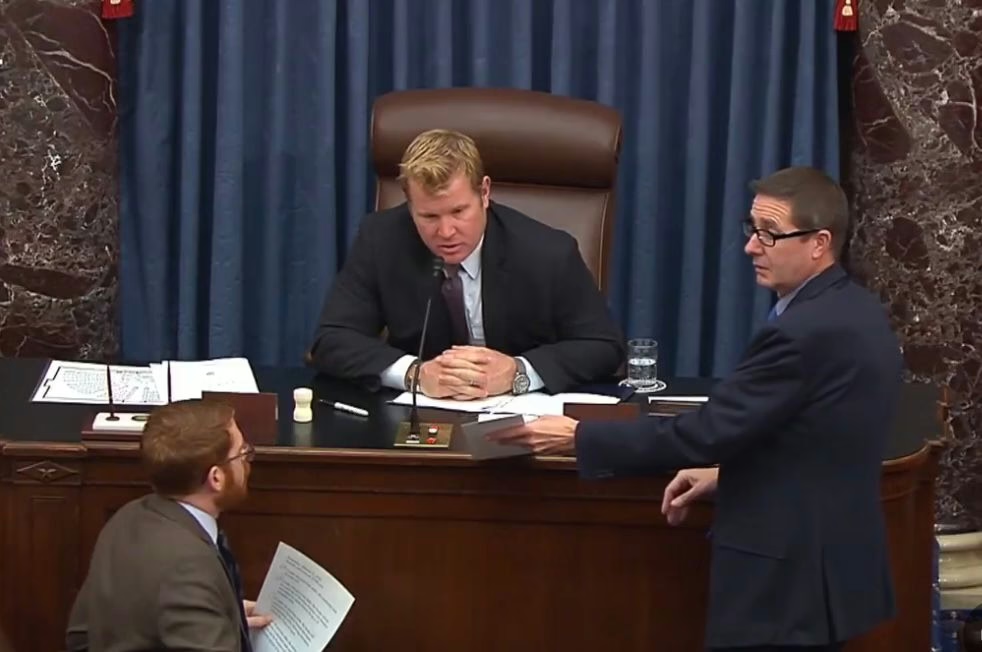
The Senate on Thursday voted in favour of blocking President Trump from taking further military action in Venezuela without congressional approval following the U.S. capture of the country’s leader, Nicolás Maduro.
Why it matters: A significant number of Republicans broke with Trump to advance the war powers resolution — a rare and notable rebuke of the president — even as most of the GOP supports the operation in Venezuela. The Senate voted 52-47 in favour of the measure, led by Sens. Tim Kaine (D-Va.) and Rand Paul (R-Ky.), and backed by Senate Minority Leader Chuck Schumer (D-N.Y.). Five Republicans — Paul, Susan Collins of Maine, Lisa Murkowski of Alaska, Todd Young of Indiana, and Josh Hawley of Missouri — joined Democrats in supporting the measure.
Last year, Senate Republicans rejected similar resolutions aimed at blocking Trump’s campaign of airstrikes against alleged drug boats off the coast of Venezuela, which have resulted in over 100 fatalities.
What’s next: Thursday’s vote was procedural but indicates sufficient support in the Senate to pass the resolution, which is anticipated to happen next week. It will then need to be considered by the House. The White House has indicated that Trump would veto the measure.
The big picture: The operation to capture Maduro has raised concerns from both parties regarding the White House’s potential consideration of strikes against Greenland and other Latin American countries, as the president has suggested.
A rare bipartisan statement from Sens. Thom Tillis (R-N.C.) and Jeanne Shaheen (D-N.H.) this week urged Trump to “respect the sovereignty and territorial integrity of the Kingdom of Denmark,” which includes Greenland. Kaine has stated his intention to introduce war powers resolutions aimed at blocking any Trump military actions in Greenland, Mexico, Cuba, Colombia, and elsewhere.
Yes, but: After briefings from top Trump officials on Capitol Hill this week regarding the Maduro raid, most Republicans appeared satisfied with the administration’s justification for the operation and the U.S.’s long-term strategy for Venezuela. Following a briefing for senior lawmakers earlier this week, House Speaker Mike Johnson (R-La.) remarked: “We do not have U.S. armed forces in Venezuela, and we are not occupying that country.”



Leave a Reply