
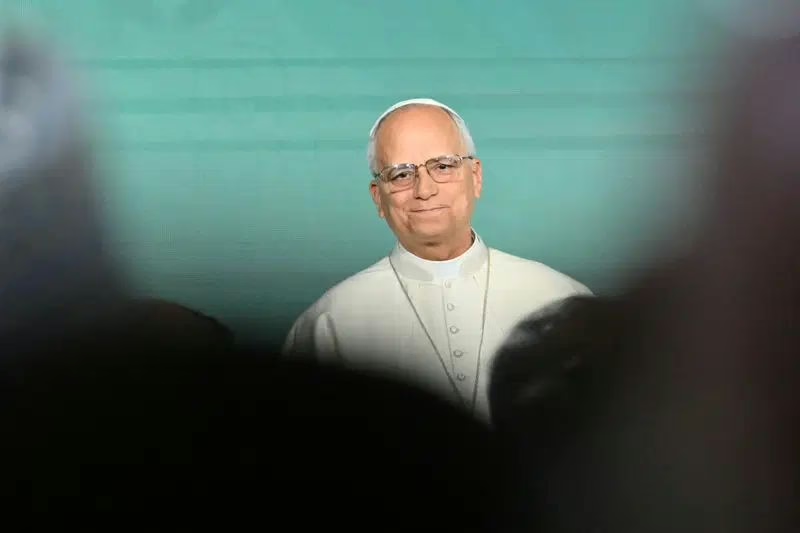
Pope Leo XIV warned on Friday that war was “back in vogue” and highlighted the “ambition of belligerents,” as his own country, the United States, flexes its military muscles.
In a New Year’s message to diplomats at the Vatican, his first since becoming head of the world’s 1.4 billion Catholics last May, Leo lamented the weakness of multilateralism, stating that dialogue was being replaced by a “diplomacy based on force.”
While he did not name the U.S., he expressed serious concern regarding rising tensions in the Caribbean and Pacific, particularly in Venezuela, where U.S. forces recently seized the president.
His remarks came just hours after U.S. President Donald Trump announced that land operations against drug cartels were imminent, following maritime attacks in the eastern Pacific Ocean and Caribbean Sea.
Leo issued an appeal “to respect the will of the Venezuelan people, and to safeguard the human and civil rights of all,” in light of Trump’s suggestion that the U.S. could effectively control Venezuela—and its vast oil reserves—for years to come.
The pope’s address encapsulated a year marked by increasing global tension, from the Russia-Ukraine war to U.S. strikes in various countries, along with rising fears in Europe regarding a possible U.S. takeover of Greenland.
He warned that the principle established after the Second World War, which prohibits countries from using force to violate the borders of others, “has been completely undermined.”
“Diplomacy based on dialogue is being replaced by a diplomacy based on force, by either individuals or groups of allies,” he stated. “War is back in vogue and a zeal for war is spreading.”
The pope remarked that peace was being “sought through weapons as a condition for asserting one’s own dominion,” warning that this gravely threatens the rule of law, which is the foundation of all peaceful civil coexistence.
The Chicago-born pontiff reiterated that adherence to international law is “a commitment that states have made” and that it “must always prevail over the ambitions of belligerents.”
He condemned the destruction of hospitals, energy infrastructure, homes, and essential places for daily life as “a serious violation” of international humanitarian law.
Leo urged the international community to remember that protecting human dignity and the sanctity of life “always counts for more than any mere national interest.”
He pointed to the “weakness of multilateralism” as “a particular cause for concern,” emphasising its purpose as a forum for dialogue, modelled on the ancient Roman Forum or medieval town square.
However, he noted that it is difficult to converse “when words lose their connection to reality, and reality itself becomes debatable and ultimately incommunicable.”
“Rediscovering the meaning of words is perhaps one of the primary challenges of our time,” he remarked.
The pope also cautioned against the “danger of returning to the race of producing ever more sophisticated new weapons,” particularly those that use artificial intelligence.
Reflecting on ongoing conflicts worldwide, the pope reiterated his support for a two-state solution in the Middle East and lamented the rising violence in the occupied West Bank.
“Sadly, there has been an increase in violence in the West Bank against the Palestinian civilian population, which has the right to live in peace in its own land,” he concluded.




Leave a Reply