
By George Omagbemi Sylvester
In a moment laden with solemnity and historic weight, the State of Israel announced the recovery of the remains of the last hostage taken into Gaza during the Hamas-led assault that began on October seventh, two thousand and twenty-three. After a protracted and painful saga that captured global attention, the discovery of the body of police officer Ran Gvili concludes one of the most anguishing chapters of the Israel-Hamas conflict and opens the door (tentatively) to a new phase of ceasefire negotiations and political recalibration.
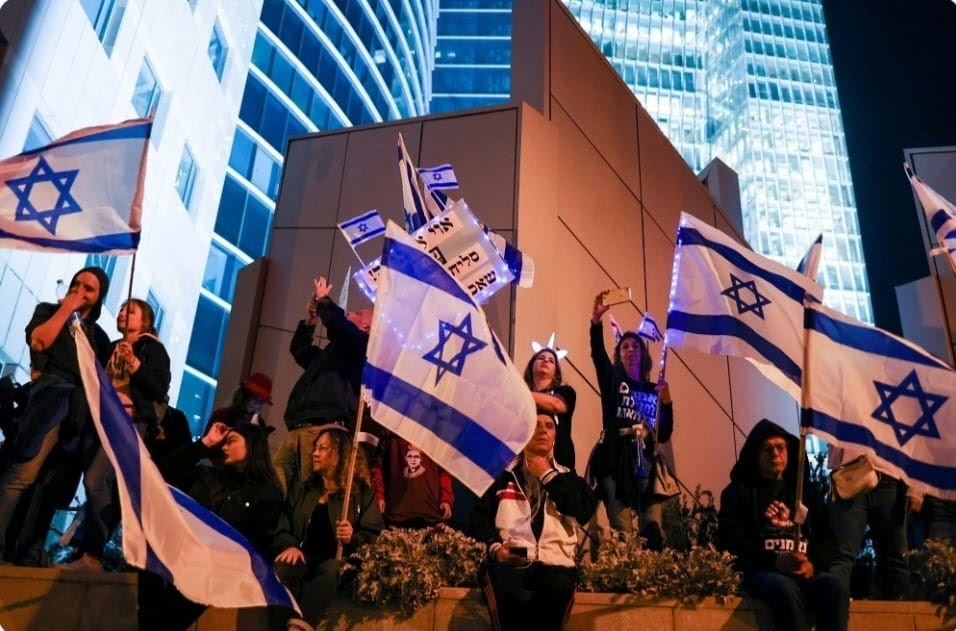
In announcing the recovery, Israeli military and political leadership underscored the symbolic and emotional importance of bringing “every last one” home, a phrase that resonated across a nation and beyond. Prime Minister Benjamin Netanyahu affirmed that the return of Gvili’s remains fulfilled a central promise to the families of the abducted and to the nation at large, reinforcing the idea that no citizen would be forgotten, alive or deceased.
A Conflict Defined by Loss, Resilience and Global Scrutiny. The conflict that erupted in early October two thousand and twenty-three was one of the most devastating in recent Middle Eastern history. Initiated by a Hamas-led attack across multiple fronts, the day’s violence saw hundreds of civilians killed and scores of hostages abducted into Gaza. The assault stunned the world, drawing international condemnation and setting in motion a brutal cycle of airstrikes, ground incursions, humanitarian crises, and diplomatic engagements.
Throughout the conflict and its aftermath, the fate of those taken hostage became a central issue, both in negotiations and in the collective consciousness of Israelis and global observers. Families of the captives held onto hope, demanding answers and action. Civil society groups, international mediators, and diaspora communities lent their voices to calls for their safe return. As the weeks turned into months and then years, the plight of the hostages became a stark symbol of the conflict’s human cost and a reminder that geopolitical struggles are lived in the intimate spaces of individual lives and family ties.
The Recovery of Ran Gvili: What It Means. Ran Gvili, a young Israeli police officer just in his mid-twenties, was among those seized during the assault. His death in combat during the initial attack rendered his captivity particularly poignant, a story of bravery abruptly cut short. The subsequent recovery of his remains after a focused military operation in northern Gaza has been widely interpreted as a measure of closure not only for his family but for a nation searching for an endpoint to a chapter defined by uncertainty and grief.
International reactions underscored the gravity of this moment. Professor Avi Shlaim, a respected historian of Middle Eastern affairs, described the recovery as “both an emotional reckoning and a stark reminder of the cost of protracted conflict,” a cost measured not just in bodies returned, but in the lives irrevocably altered. Meanwhile, Ambassador Martin Griffiths, former United Nations Under-Secretary-General for Humanitarian Affairs, noted that “no true peace can be built without confronting the human toll of war and the dead must be honored and the living must be protected.” These reflections highlight how deeply the hostage issue resonated beyond the immediate battlefield.
Ceasefire Phases and Political Implications. The return of Gvili’s remains meets a central condition of the ceasefire framework brokered with the assistance of international mediators, including the United States, Egypt, and Qatar. This framework envisioned a staged process: the release or recovery of all hostages, cessation of major hostilities, the gradual delineation of governance structures in Gaza, and eventually steps toward reconstruction and stabilization.
According to reports from neutral observers, the recovery thus clears a key obstacle to advancing the next phase of these plans, most notably the reopening of critical crossings such as Rafah, which for many Palestinians represents a lifeline to goods, services, and humanitarian aid. Yet unlocking this next phase is fraught with political and security tensions. Israeli leadership has stressed that it will pursue a cautious transition, maintaining defensive priorities even as it seeks to reduce overt conflict dynamics on the ground.
Human Stories Amid Political Realities. While the broader geopolitical narrative evolves, the human dimension remains compelling. The families of hostages (whether released, still recovering, grieving, or forever changed) embody the emotional essence of the conflict. For years, individuals like Gvili’s parents lived with unanswered questions, aspirations for reunions, and the psychological strain that comes with unresolved loss. Their resilience reflects what the scholar Johan Galtung once described as “structural endurance”—the capacity of human beings to withstand and interpret trauma within the context of broader societal ruptures.
Similarly, humanitarian organizations like the International Committee of the Red Cross have repeatedly emphasized that “each life taken or held against their will must remind us of our collective responsibility to uphold human dignity, even in times of conflict.” This moral imperative (echoed by ethicists, peacemakers, and international jurists) underscores the complexity of transforming moments of closure into sustained pathways for peace.
The Fragile Road Ahead. Reaching this point (the recovery of the last hostage’s remains) does not signify an end to the deep challenges that define Israeli-Palestinian relations. Far from it. Security concerns, questions about Hamas’s future role, governance in Gaza, displacement of civilians, economic deprivation, and regional political realignments continue to shape the lived reality of millions. As political analysts such as Shibley Telhami of the University of Maryland assert, “Any lasting resolution must confront core issues of rights, sovereignty, and justice, not simply episodic ceasefires.” Such assessments remind international audiences that temporary pauses in violence, while welcomed, do not substitute for comprehensive conflict transformation.
Global Reflections on Violence and Peace. Across the world, reactions to the news have varied, from relief at the closure of a painful chapter to sober reflections on the cost of intractable conflict. In Johannesburg, diplomats and civil society leaders alike expressed hopes that this moment could serve as a catalyst for renewed commitment to diplomatic engagement and humanitarian assistance across divided societies.
The former UN Secretary-General Kofi Annan once observed that “peace is more than the absence of war; peace is the presence of justice, the rule of law and respect for human dignity.” As global leaders articulate responses to the Israel-Hamas situation, this insight offers a lens through which to assess both immediate actions and long-term strategies.
Endnote. The recovery of Ran Gvili’s remains (the last among those taken to Gaza) resonates far beyond a single family or nation. It stands as a testament to human persistence, international diplomacy, and the enduring struggle to balance security with humanity. It recalls that while wars may seize headlines, it is the lived experiences of individuals and families that shape the moral contours of history.
As the world watches the next phase unfold, the imperative remains clear: to seek not only the cessation of violence but the cultivation of conditions where human life is protected, dignity is affirmed, and justice guides collective action. In the end, the measure of peace will not be found merely in agreements signed but in lives rebuilt and futures reclaimed.







Leave a Reply