
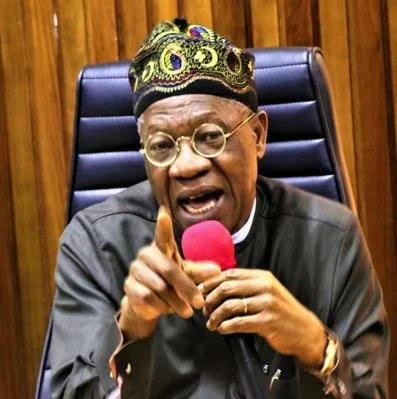
Former Minister of Information and Culture, Alhaji Lai Mohammed, has shared insights into his experiences during the administration of the late President Muhammadu Buhari, shedding light on how one of his cabinet colleagues unfairly criticised him during a Federal Executive Council (FEC) meeting.
In his newly launched book, “Headlines and Soundbites: Media Moments that Defined an Administration,” Mohammed recounts the incident involving a fellow minister from the South-West who accused him of incompetence while he was absent from the meeting. He stated, “I was in Washington, D.C. for the usual biannual engagements with the international media and think tanks.”
Mohammed learned that the unnamed minister had complained that, while the administration was performing well, the Minister of Information was not doing enough to showcase its achievements. “The President, I was told, would have none of it,” he recalled, emphasising Buhari’s immediate defence of him. “According to those present, the President immediately interjected and defended me, stating that I have been doing a great job protecting the administration from across the Atlantic.”
Throughout his tenure, Mohammed noted that President Buhari not only praised him for his successes but also stood by him during challenging times. He recalled another instance when he faced a petition alleging wrongdoing. “One day, when I went to see the President in his office, I noticed that his Aide-de-Camp (ADC) seemed a little uneasy when he saw me,” he began. After some hesitation, the ADC confessed, “Oga, I have a confession to make. Somebody wrote a petition against you, and I forwarded the petition to the President after much pressure.”
When Buhari reviewed the petition, he dismissed it by saying, “Lai? I don’t believe it,” yet he still ordered an investigation. Mohammed reflected, “When the report came back, you were found to be clean,” highlighting the President’s trust in him.
The former minister also shared a significant moment regarding a public letter from former President Olusegun Obasanjo, who had strongly criticised Buhari’s administration. Anticipating backlash, Obasanjo remarked that he expected “praise singers and hired attackers to come after him.” Mohammed noted that Buhari, out of respect for Obasanjo as a senior military figure, instructed that no one should respond to the letter. “I had discussed with Femi Adesina the need for us to respond, but he firmly told me that the President has instructed that no one should respond,” Mohammed explained.
Despite Adesina’s warning, he approached Buhari to advocate for a response, stating, “I told him politely but firmly that this was about Nigeria and that we owed it a duty to respond.” This led to an intense discussion, which was unprecedented between the President and himself. Ultimately, Buhari granted permission for a response, saying, “After much back and forth, the President reluctantly gave me the go-ahead.”
Mohammed issued a carefully crafted statement in response to Obasanjo’s letter, mindful of Buhari’s instruction to avoid insulting the former President. “Fortunately, I did not disappoint him,” he remarked, later receiving commendations from Buhari and others for the professionalism of his response.
Another noteworthy incident involved Mohammed’s plans to escort local and international journalists to territories reclaimed from Boko Haram in 2015. Just as he was set to go, he received last-minute news from the then Minister of Defence, who insisted that the trip required the President’s approval. Mohammed quickly contacted the Chief of Staff, who managed to reach Buhari in South Africa. “The President gave his approval for the trip, even when I had not previously discussed it with him,” he recounted.
Highlighting Buhari’s support for his initiatives, Mohammed noted, “With a paltry budget for the massive ministry I oversee, it was almost impossible to implement our programmes.” He relied on special interventions from the President to carry out key initiatives.
In closing, Mohammed reflected on the lasting legacy of Buhari’s presidency, stating that what lingered most was the late leader’s “quiet faith in trust.” He expressed that when Buhari entrusted someone with responsibility, he also granted them the freedom to act, believing that “duty carried its own wisdom.”



Leave a Reply