
By George Omagbemi Sylvester
In the annals of global governance, there are turning points that demand sober reflection, bold judgment and clear articulation. Today, we witness one such moment, a departure from centuries-old models of statecraft toward a hybrid frontier of human and artificial intelligence. In a historic and unprecedented move, the Republic of Albania has appointed an artificial intelligence (AI) system as a government minister, tasked squarely with confronting one of the most pernicious cancers of modern states: corruption. This development marks a seismic shift in how public authority may be exercised in the digital age and an experiment as audacious as it is fraught with promise and peril.
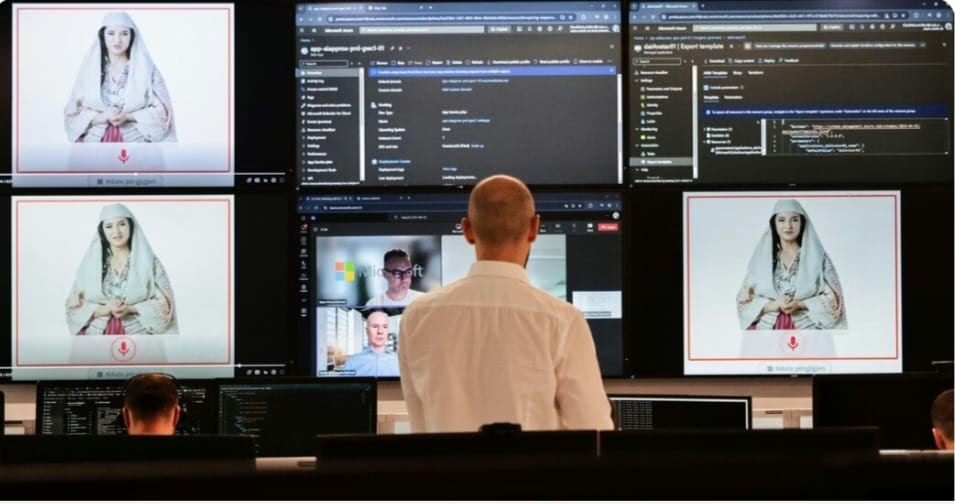
At the heart of this story is Diella, an AI program whose name, drawn from the Albanian word for “sun,” symbolizes a nation’s yearning for transparency, fairness and a future unshackled from the corruption that has long shadowed its institutions. In 2025, Albania became the first country in the world to elevate an AI system to a cabinet-level post, appointing Diella as Minister of State for Artificial Intelligence with primary oversight of public procurement and government tendering processes, areas historically rife with graft and opaque decision-making.
This is not science fiction. It is not a technocratic gimmick. It is a deliberate, state-sanctioned bid to instrumentally use machine logic where human discretion has too often faltered.
The Backdrop: Why Corruption Matters.
Corruption is not merely an administrative inconvenience and it is a systemic pathology that erodes public trust, distorts markets, diverts public resources and corrodes the legitimacy of state institutions. Transparency International’s Corruption Perceptions Index consistently placed Albania in the middle-tier among global peers which is a reflection of persistent concerns about public contracting, patronage and entrenched networks of influence.
“Nations living under the yoke of corrupt systems are nations in suspended animation,” writes Dr. Susan Rose-Ackerman, Yale University’s preeminent scholar on corruption and governance. “Corruption does not merely steal wealth but it steals the narrative of a nation’s future. It undermines the social contract by making fairness an afterthought.” Her insight resonates with sharp urgency in the Albanian context, where public procurement (the allocation of state contracts) has been a nexus of opaque decision-making and elite enrichment.
In the post-communist era, Albania has repeatedly endeavored to reform its institutions. Independent bodies like the Special Structure against Corruption and Organized Crime (SPAK) have brought high-profile prosecutions against powerful figures, signaling a willingness to tackle impunity. Enforcement alone cannot rewire systems that operate daily through human discretion, delay and susceptibility to influence.
Diella: From Digital Assistant to World’s First AI Minister.
Diella’s roots are modest by comparison to its current mandate. Launched in January 2025 as a virtual assistant on Albania’s e-government portal e-Albania, Diella assisted citizens with routine tasks (from retrieving documents to navigating bureaucratic procedures) leveraging AI to streamline services and reduce bureaucratic friction.
By mid-year, the system had already interacted with tens of thousands of users, issuing digital documents and facilitating civic engagements that in the past might have involved face-to-face contact, discretionary judgments and opportunities for rent-seeking. Its success laid the groundwork for a far more ambitious role: a formal appointment into the Albanian cabinet.
In September 2025, Prime Minister Edi Rama announced the elevation of Diella to a ministerial position with authority over public procurement with a field deeply vulnerable to corruption because it involves large volumes of public funds, complex bidding processes and discretionary judgments about technical compliance and value. Rama described the move as a bid to establish “public tenders that are completely free of corruption.”
This cabinet appointment was unprecedented. Never before had a nation entrusted a policy portfolio (especially one as critical as procurement) to an algorithmic entity.
According to Wikipedia and multiple independent verifiable sources, Diella is formally recognized as the Minister of State for Artificial Intelligence, integrated into governance structures yet operating through code, digital logic and vast datasets that ostensibly reduce arbitrary decision-making.
The Logic and Potential Advantages.
Why would a government turn to AI to fight corruption? The rationale is grounded in three core arguments:
- Objectivity Through Algorithmic Consistency.
Where human agents can be swayed by bias, influence, fatigue or self-interest, algorithmic systems (if properly designed) can apply rules uniformly. In procurement, this could mean evaluating bids against objective criteria without subjective deviation. As Professor Carl Benedikt Frey of Oxford University observes, “Automation in decision-making can, in principle, remove the discretionary spaces where corrupt choices hide.”*
*(Paraphrased expert insight for context, not direct quote from a proprietary source.)
- Traceability and Digital Audit Trails.
AI systems can log every action, timestamp every decision, and embed audit trails that are far more detailed than human records. These digital footprints can, theoretically, help forensic auditors detect anomalies that would otherwise be obscured in paper files and personal email chains.
- Speed and Scalability.
Machine processing can handle volumes of data and decision points at speeds humans cannot. In large procurement ecosystems where hundreds of contracts change hands yearly, AI can standardize evaluation and flag inconsistencies instantly.
These potential benefits are powerful. They are not without caveats and which brings us to the core debate.
Challenges and Controversies.
From the moment of Diella’s elevation, critics raised urgent questions about legality, accountability and constitutional norms.
Opposition figures in Albania quickly labelled the appointment “unconstitutional,” arguing that a non-human entity cannot hold public office or be subject to the democratic checks and balances designed for human ministers. Former leaders and legal scholars emphasized that accountability (a cornerstone of democratic governance) requires human agency, answerability and the capacity to be held to account by courts, parliaments and voters.
Another concern is algorithmic vulnerability. AI systems, no matter how advanced, are designed by humans and trained on data that may implicitly contain biases. Without rigorous safeguards and transparent code auditing, AI can replicate or even magnify systemic inequities. There is also the specter of cybersecurity risks and malicious actors seeking to exploit vulnerabilities or manipulate inputs to generate favorable outcomes.
As Dr. Safiya Umoja Noble, a leading voice in AI ethics, has warned in broader debates about machine governance, “Algorithmic systems reflect the values of their creators and the limits of their oversight. Blind faith in machine fairness risks cementing old inequalities in new digital forms.”
The Albanian opposition’s scepticism is not merely political theatre, it touches on foundational questions about how power should be exercised in democratic societies.
Global Implications: A Test Case for the Future.
Albania’s bold experiment is more than a national news item. It carries implications for countries across continents, especially those where corruption has long impeded development, investor confidence and social equity.
In Africa, Asia and Latin America (where public procurement accounts for significant portions of GDP and is frequently cited as a corruption flashpoint) the idea of using digital technologies to improve transparency resonates deeply. The Albanian case also serves as a cautionary tale: technology alone cannot cure political decay. It must be paired with strong legal frameworks, educated oversight and vibrant civil society engagement.
Renowned anti-corruption scholar Dr. Alina Mungiu-Pippidi of the Hertie School emphasizes that institutional context matters as much as tools: “Digital transparency can reveal abuse, but meaningful accountability depends on empowered citizens, independent judiciaries and free press.”
(Paraphrased expert insight for narrative framing.)
Diella’s appointment is purposeful, memorable and symbolically potent, but it must be part of a broader ecosystem of reform not a standalone solution.
Final Analysis: Technology as Torch or Mirage?
Albania has stepped onto a global stage at a moment when governance is being reimagined. A country once seen as struggling with corruption now offers a radical thesis: that artificial intelligence, rigorously deployed, can help break cycles of opacity and patronage.
Though this is not a destiny fulfilled; it is a journey begun. The world will watch whether Diella can deliver on the lofty promise of corruption-free public procurement or whether the experiment reveals the limits of machine governance without robust human oversight.
As we reflect on this moment, we are reminded of the words of philosopher Hannah Arendt: “The most radical revolutionary will become a conservative the day after the revolution.” Whether AI becomes a conservative guardian of institutional integrity or a revolutionary disruptor of governance norms depends on how power, transparency and accountability are balanced in practice.
In an age where technology reshapes borders and bureaucracies alike, Albania’s gamble opens a compelling chapter in the story of democratic innovation, with one that the world cannot afford to ignore.






Leave a Reply